
Machine Learning · Editable reference architecture
Speech recognition system architecture
An editable speech recognition system architecture reference showing Audio input → Chunking → Speech model and downstream dependencies. Keep timing and speaker metadata traceable.
Open & Edit in DrawArc (Free, No Login Required)Your changes stay in a separate draft on this browser. Download an editable project to keep a portable copy.
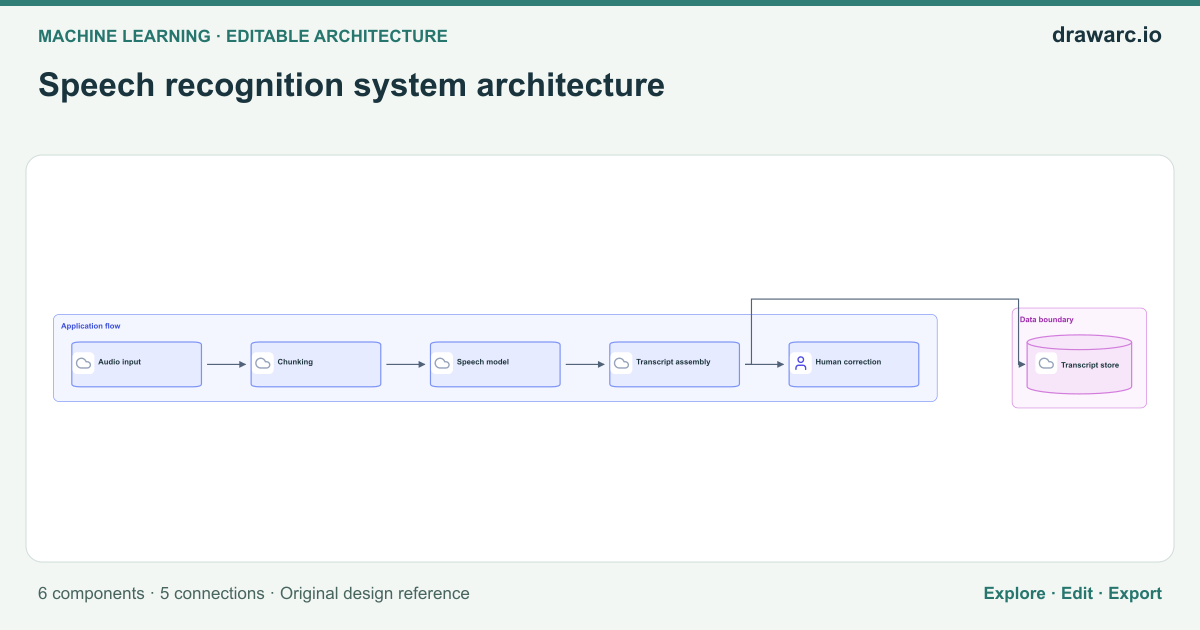
6 components · 5 connections · Open the editor to zoom, move nodes and edit source.
Architectural overview
Speech recognition system architecture addresses the responsibilities and boundaries shown in this reference rather than prescribing an entire production deployment. The primary flow starts at Audio input and reaches Transcript store through Chunking, Speech model, Transcript assembly. Use this view to explain which component initiates work, which component owns a decision, and where a dependency can affect the caller. Keep timing and speaker metadata traceable.
The diagram contains 6 distinct components and 5 directed relationships. A separate path connects Transcript assembly → Human correction. These arrows describe logical interactions; they do not establish authentication, network access, atomic transactions or delivery guarantees. Label the actual protocol, payload contract and owner when adapting the drawing to your system. Keep synchronous and asynchronous boundaries explicit so that a reviewer can identify where a request ends and a later operation begins.
Before implementing this architecture, define expected load, data classification, latency budgets and recovery objectives. Give Audio input a bounded dependency timeout and a documented failure response. For Transcript store, specify ownership, retention, access control and a tested recovery procedure. Validate the decision above against your workload instead of treating the presence of a component as proof of reliability. Open the editable canvas, replace generic labels with real deployment units, and document the decisions that differ from this reference.
The real-world problem
Design or explain speech recognition system architecture with explicit ownership and dependency paths. Keep timing and speaker metadata traceable.
Data flow
Connections from this diagram. Branches and control signals are not a single chronological sequence.
- Audio input → Chunking. Define the interaction contract and trace the resulting response or state change.
- Chunking → Speech model. Define the interaction contract and trace the resulting response or state change.
- Speech model → Transcript assembly. Define the interaction contract and trace the resulting response or state change.
- Transcript assembly → Transcript store. Define the interaction contract and trace the resulting response or state change.
- Transcript assembly → Human correction. Define the interaction contract and trace the resulting response or state change.
Security boundaries
- Authenticate callers at the boundary before Chunking accepts protected work; authorize the specific operation rather than trusting network placement.
- Use separate service identities and least-privilege permissions for Chunking, Speech model, Transcript assembly. Encrypt sensitive traffic, protect credentials and avoid placing confidential payloads in logs.
- Restrict and audit access to Transcript store; define retention and deletion requirements for the actual data.
Failure handling
Audio input is unavailable or slow
Response: Apply bounded timeouts and controlled backoff only where retrying is safe. Return an explicit failure or durable acceptance; do not report success before required work is committed.
Verify: Interrupt Audio input in an isolated test and measure errors, recovery and any repeated side effects.
Transcript store loses or returns stale state
Response: Use workload-specific durability, reconciliation and tested recovery. Specify how stale reads or a failed write affect callers.
Verify: Exercise the failure path with representative records and verify both the visible response and the resulting state.
An invalid or incompatible input reaches Chunking
Response: Validate the input contract before effects are committed. Preserve rejected input identifiers without exposing secrets, and document a safe replay or correction procedure.
Verify: Send malformed and older-version inputs through Audio input and verify rejection, observability and unchanged valid state.
Trade-offs and alternatives
Keep timing and speaker metadata traceable.
- Benefit
- Makes the ownership and interaction boundaries visible for a focused design review.
- Cost
- The 6 illustrated components still require contracts, monitoring and operational ownership; extra boundaries can add latency and failure modes.
- Alternative
- Use a simpler deployment when it meets the same requirements, or split a boundary only after measuring a specific need.
Logical boundaries versus deployment units in Speech recognition system architecture
- Benefit
- Keeps the responsibilities of Audio input, Chunking, Speech model visible without requiring a separate server for each box.
- Cost
- A logical view does not establish isolation, independent scaling or high availability; those require a separate deployment design and operational tests.
- Alternative
- Co-locate components in a simpler deployment first when ownership and workload requirements permit it.
When to use this architecture
- Explain speech recognition system architecture to engineers or stakeholders using a concrete visual flow.
- Review this decision before deployment: Keep timing and speaker metadata traceable.
- Adapt a starting diagram for your own requirements, then record and validate every changed boundary.
Key components
- Audio input
- Audio input participates in speech recognition system architecture. Audio input → Chunking. Define its contract, owner and access permissions in your implementation.
- Chunking
- Chunking participates in speech recognition system architecture. Audio input → Chunking; Chunking → Speech model. Define its contract, owner and access permissions in your implementation.
- Speech model
- Speech model participates in speech recognition system architecture. Chunking → Speech model; Speech model → Transcript assembly. Define its contract, owner and access permissions in your implementation.
- Transcript assembly
- Transcript assembly participates in speech recognition system architecture. Speech model → Transcript assembly; Transcript assembly → Transcript store; Transcript assembly → Human correction. Define its contract, owner and access permissions in your implementation.
- Transcript store
- Transcript store participates in speech recognition system architecture. Transcript assembly → Transcript store. Define its contract, owner and access permissions in your implementation.
- Human correction
- Human correction participates in speech recognition system architecture. Transcript assembly → Human correction. Define its contract, owner and access permissions in your implementation.
Questions about this template
What does this speech recognition system architecture diagram show?
It shows 6 components with the core flow Audio input → Chunking → Speech model → Transcript assembly → Transcript store. Keep timing and speaker metadata traceable.
Can I edit this diagram without signing in?
Yes. Open the template in the browser-local canvas to change nodes, connections and source. AI generation and cloud account storage require sign-in.
Is this a complete production implementation?
No. It is an editable reference. Validate the security controls, dependency behavior, capacity and recovery plan against your own requirements before implementation.
Validate your implementation
Use the relevant platform documentation to verify service limits, supported features and configuration. This diagram is an original reference rather than a reproduction of a provider deployment.